
If you’re a club volleyball parent, you’ve probably felt it: the quiet panic that your daughter has to make it to USAV Nationals or her college dreams are over. Take a breath. That fear is one of the most common volleyball recruiting myths out there — and it drives a lot of unnecessary stress (and spending) every single season.
The truth is more encouraging than the rumor mill suggests. College coaches recruit from many events, in many ways, at many levels. A bid to Nationals is a wonderful accomplishment — but it is not a golden ticket, and missing one is not a closed door.
Here’s the honest breakdown of what bids and Nationals really mean for recruiting, what coaches are actually watching for, and what a trip to Nationals really costs your family.
Table of Contents
First, What Does Earning a Bid to Nationals Actually Mean?
A “bid” is an invitation to the USA Volleyball Girls Junior National Championship (GJNC), earned by performing well at a designated USAV qualifier tournament. Qualifiers are big, competitive weekends, and finishing high enough in your division earns your team a spot at the national event.
It’s a real achievement worth celebrating. Earning a bid means your team competed hard against strong opponents and came out near the top.
But here’s the part that gets lost in the bid-day excitement: a bid is one path to high-level postseason play — not the only one. Understanding the full landscape takes the pressure off.
5 Volleyball Recruiting Myths That Cause the Most Parent Anxiety
These are the volleyball recruiting myths we hear most often from families — and the reality behind each one.
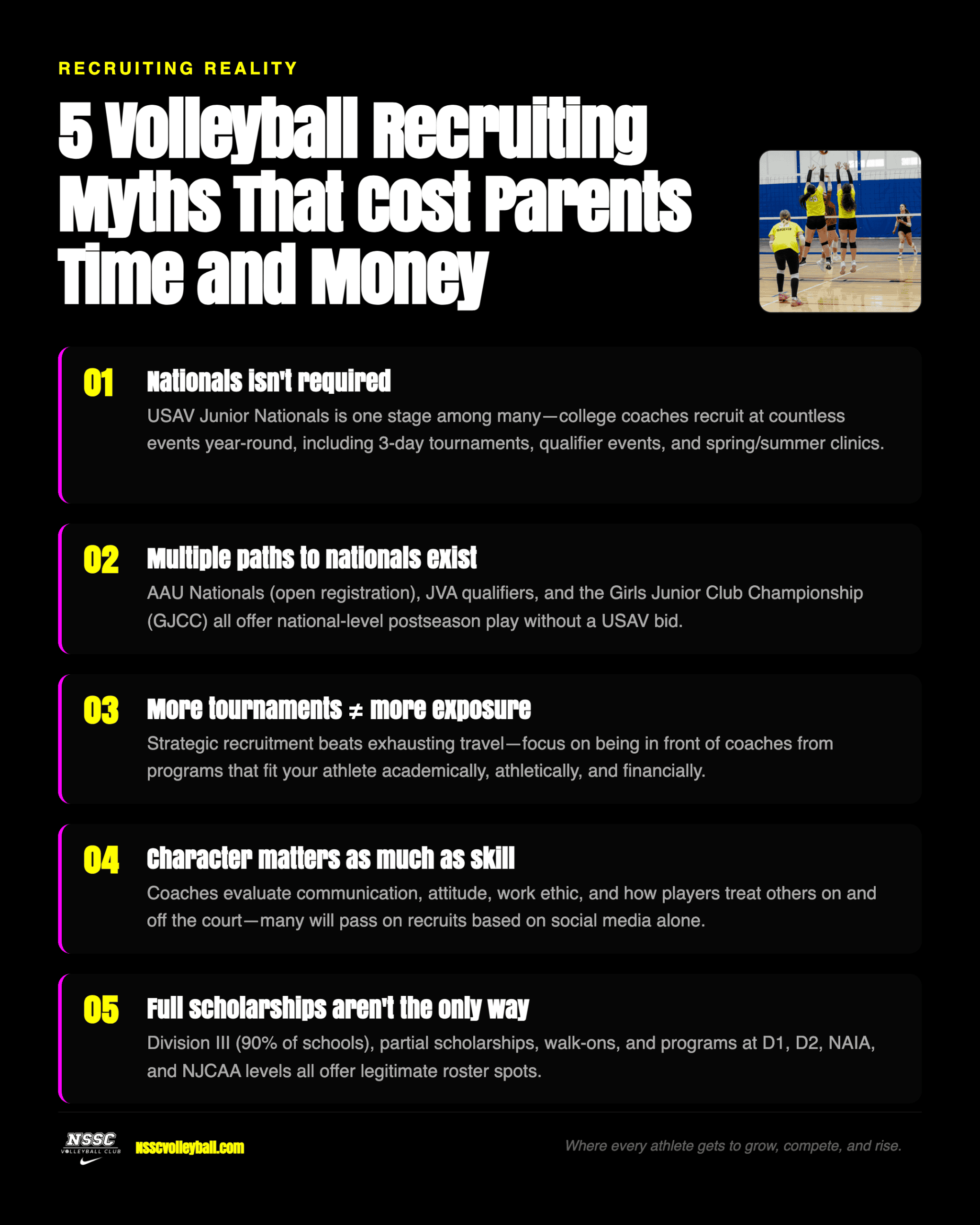
Myth #1: You have to attend USAV Nationals to get a college offer
This is the biggest misconception in club volleyball. USAV Junior Nationals requires a bid earned at qualifiers, but it is far from the only stage where athletes get seen. College coaches recruit at countless events throughout the year, not just at GJNC. What matters most is being seen by the right coaches at events where your target schools are actually scouting.
This could mean large 3 day tournaments, USAV Qualifier events, or even attending multi-college clinics in the spring and summer months.
Myth #2: A bid is the only way to play national-level postseason volleyball
Not true. AAU Nationals in Orlando is open registration — no qualification required. The JVA hosts its own qualification events that don’t depend on a USAV bid. And beginning in 2026, USA Volleyball launched the Girls Junior Club Championship (GJCC) specifically for teams that weren’t bid-eligible for GJNC — an acknowledgment that talent runs deep well beyond the bid-qualifying teams. For a deeper look, see our guide to post-season national volleyball tournaments: USAV, AAU, and JVA.
Myth #3: More tournaments and more travel equal more recruiting exposure
Exposure isn’t about racking up the most weekends away. It’s about being in front of the coaches who are recruiting for programs that actually fit your athlete — academically, athletically, and financially. A focused plan beats an exhausting (and expensive) one.
Myth #4: Coaches only care about your skills
Coaches evaluate far more than how hard your daughter swings. They watch communication and character — how players treat coaches, teammates, and parents before, during, and after matches. They want athletes with positive attitudes, strong work ethic, and a willingness to improve. Many coaches will even pass on a recruit based on their social media. Who your athlete is matters as much as what she can do.
Myth #5: No scholarship means no college volleyball
There is a place to play at nearly every level. Volleyball is a varsity sport at about 90% of NCAA Division III schools (which don’t offer athletic scholarships), and partial-scholarship and walk-on opportunities exist at D1, D2, NAIA, and NJCAA programs. A full ride is not the only way onto a college roster.
What College Coaches Are Actually Evaluating
If Nationals isn’t the magic key, what is? Here’s what consistently moves the needle in recruiting:
- Being seen by the right coaches — target 25–50 schools based on location, academics, division level, school size, and scholarship fit, then play where those coaches scout.
- Game film that respects their time — send a focused 5–10 minute highlight segment from a match with plenty of strong contacts. Few coaches watch more than a few minutes.
- A complete recruiting profile — highlight video, game footage, your playing schedule, and current contact info.
- Communication and character — coaches recruit people, not just positions.
- Academics — for NAIA, D3, and JUCO especially, transcripts and test scores carry real weight.
The throughline: club volleyball matters. According to the USA Volleyball recruiting resources, the overwhelming majority of women’s college players competed in both club and high school volleyball. Club is integral to the pathway — but which single tournament you attend is not the deciding factor.
“Be a good teammate. Coaches watch you all the time, not only when you are in the game or touching the ball.”
— Robert Machan, Head Women’s Volleyball Coach, Sacred Heart University
What Does It Actually Cost to Send Your Athlete to USAV Nationals?
Let’s talk about the part nobody puts on the celebratory bid-day graphic: the price tag.
Earning a bid to the GJNC is a genuine accomplishment. But before you start planning the trip, it helps to know what you’re really signing up for — because the entry fee is only a sliver of the total.
Here’s a realistic look at what a family can expect to spend:
- Team entry fee: Roughly $1,200–$1,800 per team, usually split across the roster (about $100–$200 per athlete). This is typically folded into club dues or a separate Nationals assessment.
- Hotel: Nationals is a “Stay & Play” event, meaning housing must be booked through the official travel partner. Plan on $900–$1,500 for four to five nights.
- Travel: Flying a family runs $1,200–$2,000. Driving is far gentler on the budget — closer to $200–$400 in gas.
- Spectator passes: Every spectator needs a paid entry code, usually $45–$75 per person.
- Food: Figure $400–$700 for a five- to six-day trip.
- Extras: Parking, photos, team gear, and merch can add another $200–$400.
All in, most families spend somewhere between $2,500 and $5,500 per athlete — landing around $3,000–$4,000 if you fly, and noticeably less if you can drive.
We share this not to discourage anyone, but because we believe families deserve the full picture before the emotions of bid day. A trip to Nationals can be one of the best weeks of your athlete’s club career. It can also be a real financial stretch — and there is zero shame in deciding it’s not the right year for your family. Your daughter’s growth, her love of the game, and her college pathway do not hinge on one tournament.
This is exactly why NSSC keeps so much of our competition regional and self-hosted when we can: high-level play without the travel bill that comes with chasing every national event. It’s also why our new 2026–27 high school team structure includes a Black Regional level — a real college-recruiting track that attends just one qualifier with far less travel.
And Don’t Forget the Cost of Chasing the Bid
Here’s what often gets overlooked: qualifiers carry their own price tag — it just comes in long-weekend doses instead of one big trip. At NSSC, our Nike 10U–14U teams typically attend two qualifiers a season, usually in St. Louis and Kansas City, while our high school Nike teams (15U–18U) may attend two or three. The good news: your qualifier entry fees are already built into the cost of the season, so that piece is covered. What families budget for on top of that is the travel — two to three hotel nights per event (often “Stay & Play” through the official partner), gas or flights, gate or spectator fees for every family member, and meals on the road. Realistically, that runs $800–$1,500 per qualifier weekend, and it adds up across a season. We share this not to scare anyone off, but so families can plan for the whole season — the road to Nationals included — rather than being surprised one weekend at a time.
Best Strategies to Get Recruited
So if Nationals isn’t the magic key, what actually works? Recruiting rewards athletes who take initiative. Here are three of the most effective strategies:
- Reach out to coaches directly. Don’t wait to be discovered. Proactively email college coaches your tournament schedule, academic transcript, and a link to your highlight or skills video. A short, personal note to a program that genuinely fits you beats a hundred passive hopes that someone notices you in the gym. (USA Volleyball recruiting guidance)
- Attend college prospect camps. Individual camps hosted by the specific schools you’re interested in put you directly in front of that coaching staff — exactly the people making roster decisions. It’s some of the most valuable face time you can get. (Camps, combines & summer events)
- Build a recruiting profile. Create a profile on a recruiting network like NCSA so coaches can find your video, stats, and schedule in one place and boost your visibility.
For more tools and recruiting resources, University Athlete is also worth a look. The throughline across all of these: the athletes who get recruited are the ones who put themselves in front of the right coaches — not just the ones who happen to make a national bid.
“Do not be afraid to reach out to a coach… We cannot see everyone, it’s impossible, so make yourself known.”
— Josh Stokes, Head Women’s Volleyball Coach, SUNY Potsdam
The NSSC Philosophy: Talent Is Built on Hard Work, Not Hype
At NSSC, we believe opportunity shouldn’t be reserved just for “elite” athletes. Other clubs turn kids away. We give them a place to rise. With teams across every level, we meet athletes where they are and coach them forward — from 10U beginners to 18U collegiate hopefuls.
That same belief shapes how we talk about recruiting. We won’t sell families the idea that one bid, one tournament, or one expensive trip determines a young athlete’s future. We’d rather build real skill, real character, and real confidence — the things college coaches actually recruit, and the things that serve your daughter long after her playing days.
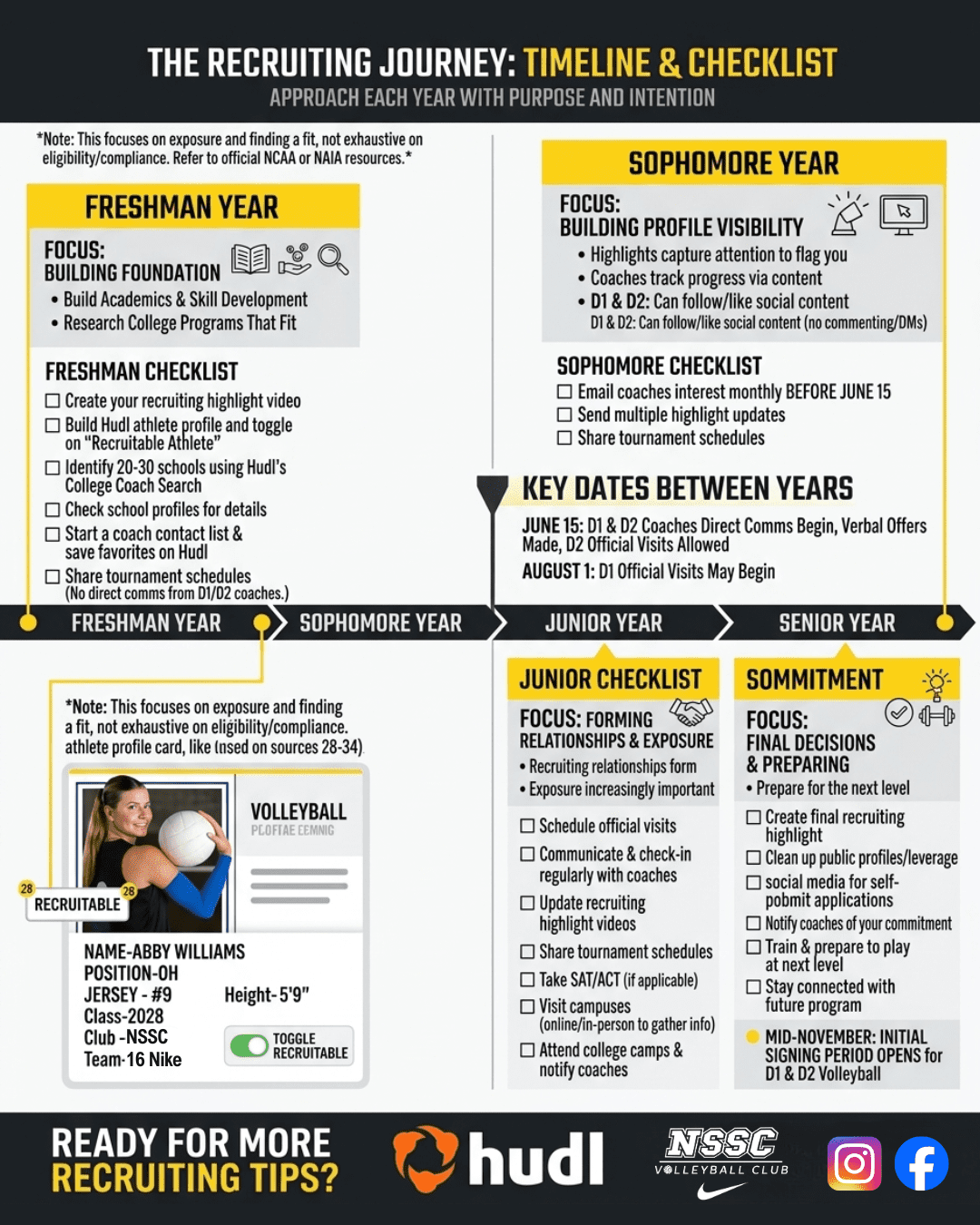
If college volleyball is the goal, we’ll help you build a smart, realistic plan. And if you want a starting point, our year-by-year volleyball recruiting checklist walks you through what to do at every age.
Frequently Asked Questions
Q: Do you have to go to USAV Nationals to get recruited for college volleyball?
A: No. This is one of the most common volleyball recruiting myths. College coaches recruit at many events year-round, and athletes also get seen at AAU Nationals, JVA events, and the new GJCC. Being seen by the right coaches matters far more than attending one specific tournament.
Q: When can college coaches make an offer?
A: For NCAA Division I and II women’s programs, coaches can make a verbal offer after June 15 of a recruit’s sophomore year. The written National Letter of Intent isn’t issued until mid-November of senior year. Many offers happen after fall campus visits.
Q: Is club volleyball necessary for college recruiting?
A: Effectively, yes. In an NCAA survey, more than 90% of women’s college volleyball players reported playing both club and high school. Club volleyball is integral to development and to the recruiting pathway.
Q: How much does it cost to send an athlete to USAV Nationals?
A: Most families spend between $2,500 and $5,500 per athlete once you add entry fees, mandatory Stay & Play hotels, travel, spectator passes, food, and extras — usually around $3,000–$4,000 if you fly and less if you drive.
Q: Can you play college volleyball without a scholarship?
A: Yes. Volleyball is a varsity program at about 90% of NCAA D3 schools (no athletic scholarships), and partial-scholarship and walk-on roster spots exist at D1, D2, NAIA, and NJCAA programs.
The Bottom Line for NSSC Families
Bids and Nationals are exciting milestones — but they’re milestones, not gatekeepers. The athletes who get recruited are the ones who keep developing, communicate well, carry themselves with character, and put themselves in front of coaches who fit. None of that requires chasing every national event or stretching your family’s budget to the breaking point.
If you have questions about your athlete’s path, talk to us. At NSSC, we’ll give you the honest picture and help your daughter grow — because national-level talent is built on hard work, not hype.
Ready to find the right fit for your athlete? Learn more about NSSC Volleyball Club and how we help every player grow, compete, and succeed.
Sources: