
If your daughter dreams of playing in college, it’s easy to think Division I is the only goal worth chasing. But here’s the truth most families never hear: the biggest, most realistic college volleyball opportunities live at the D2, D3, JUCO, and NAIA levels. These programs hand out real scholarships, real playing time, and real degrees every single year, and they’re recruiting hard right now. At NSSC, we’ve watched our athletes turn these paths into college careers without spending a fortune to get there. Here’s what these levels actually offer, the few trade-offs to weigh, and how the right club schedule gets your athlete seen.
Table of Contents
The College Volleyball Opportunities Most Families Overlook
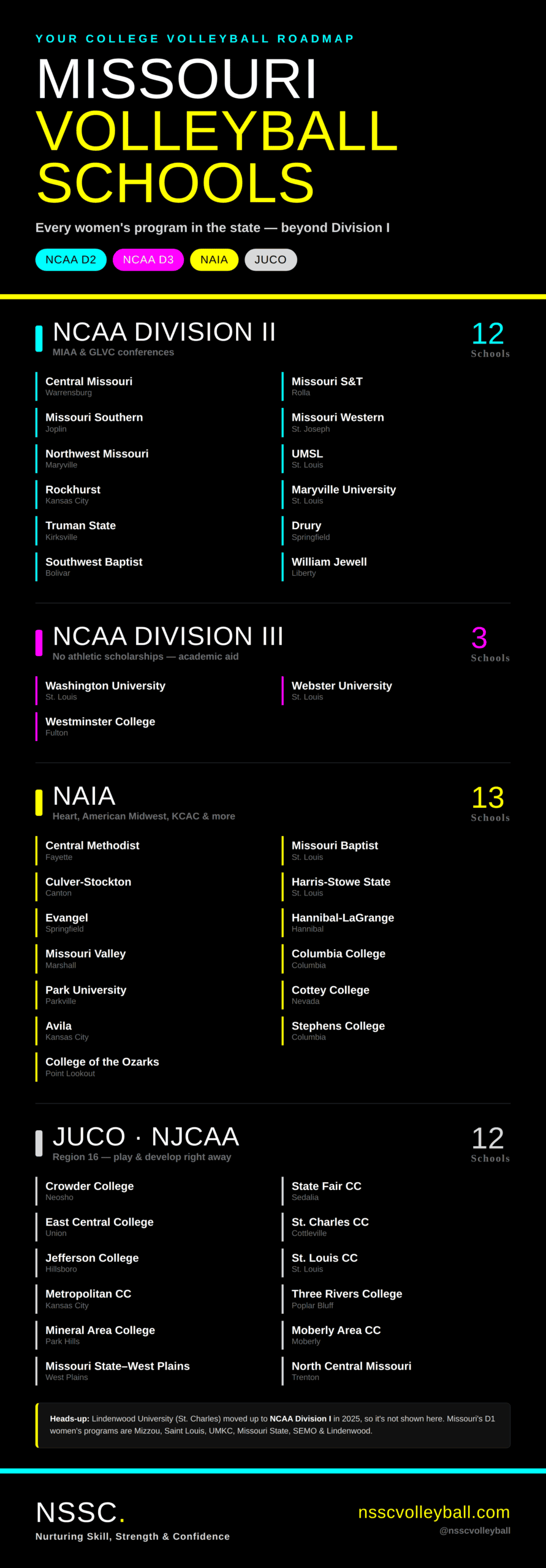
Division I gets the highlight reels, but it’s the smallest slice of the pie. The overwhelming majority of college roster spots and scholarship dollars sit at the D2, D3, JUCO, and NAIA levels. That’s not a consolation prize. That’s where most college volleyball actually happens.
When you widen the lens beyond D1, the opportunity gets a lot bigger and a lot more attainable:
- NCAA Division II offers partial athletic scholarships and a strong balance of high-level competition with real academic life.
- NCAA Division III doesn’t offer athletic scholarships, but the academic and merit aid at these schools is often generous, sometimes covering more than a partial athletic ride would.
- NAIA schools award athletic scholarships, tend to be smaller and community-focused, and often recruit athletes who develop later.
- JUCO (junior college) is a powerful launchpad in its own right, with scholarship money, immediate playing time, and a proven track record of moving players up to four-year programs.
The point is simple: your athlete has more paths to play than the D1-or-nothing story suggests. And every one of those paths is a legitimate way to earn a spot, earn aid, and keep competing.
The Pros of Playing D2, D3, JUCO & NAIA Volleyball
For most athletes, these levels aren’t the backup plan. They’re the better plan. Here’s why.
More roster spots and a realistic shot
There are simply far more programs and open spots at these levels than at D1. That means a hardworking, coachable player who loves the game has a genuine chance to make a roster and contribute, instead of chasing a handful of ultra-competitive D1 spots.
Real scholarship money
D2 and NAIA programs offer athletic scholarships, JUCO programs offer aid and a bridge to four-year schools, and D3 schools lean on academic and merit awards that can add up fast. Playing at these levels is one of the smartest ways to make college more affordable, not less.
Lauren Hansen, Director, My Recruiting Assistant
“Junior College can be a great route for a student-athlete for various reasons. Maybe they need to work on getting their grades up to play at the D1 or D2 level…”
“More and more opportunities present themselves to the Junior College transfer athlete as compared to the high-school junior or senior because these JUCO transfers have both academic and athletic experience under their belt and are more likely to come and make an immediate impact.”
(Source: Prep Dig.)
Playing time that develops you
At many D1 programs, freshmen ride the bench for a year or two. At the D2, D3, JUCO, and NAIA levels, athletes often step onto the court early, get real reps, and grow faster because they’re actually playing.
Alicia Williams, Head Volleyball Coach, Iowa Western Community College — on why JUCO, and the recruiting pitch to players and to four-year schools:
“We give players the chance to play right away, and in doing so they mature in such an amazing way.”
“In order to get better at volleyball, we need to actually play volleyball. Junior colleges give players just that.”
“They have the opportunity to play all four years, AND WIN all four years.”
“Universities flock to us in order to get that immediate impact kid with experience at a high level.”
“The great thing about JUCO transfers is that by the time they are 20 years old, they have a lot better understanding of their wants and needs than when they were 15 years old.”
A healthier balance
Smaller schools and these divisions frequently offer a saner travel load and a stronger academic-athletic balance. Athletes get to be students, not just players, and many find a tight-knit team and campus community that feels like home, which is exactly the kind of environment we value at NSSC.
Renee Lopez, author and former college coach –
At DII/DIII programs it’s “easier to find the balance of being a student, an athlete, and still be involved in other campus activities,” whereas at D1 an athlete “may not be able to pursue the academic major you wish.”
(Source: Renee Lopez Coaching.)
The Few Cons Worth Knowing
We believe in being honest with families, so here are the trade-offs, and they’re smaller than most people assume.
The main one is spotlight. D1 carries more national visibility, bigger budgets, and larger facilities. If your athlete’s dream is specifically televised, top-tier D1 volleyball, these levels won’t scratch that itch. D3 also doesn’t offer athletic scholarships, so families need to compare the academic and merit aid package carefully rather than assuming no athletic money means an expensive school. And because these programs sometimes recruit a little later and with smaller staffs, athletes need to be proactive: keep film updated, reach out to coaches, and stay on the radar.
None of these are dealbreakers. They’re just things to plan for, and a good club helps you plan for all of them.
Tom Kovic, former NCAA Division I coach, now recruiting consultant — on how D3 (and academically selective) coaches actually recruit:
D3, Ivy, and Patriot League coaches “use a slightly different formula when identifying potential prospects. The evaluation begins in the classroom and not on the playing field.”
“Coaches are hungry for academic information (transcripts, high school profile, and standardized testing) that will help them compute a rough admissions index.”
“Just over 25% of college athletes qualify for an athletic scholarship, and the competition for these grants is fierce.”
The reality he’s naming: D3 offers no athletic scholarships, so the leverage is academic — you use athletics to gain admission and merit/need aid, not an athletic ride. (Source: D3sports.com, “On Recruiting.”)
How NSSC Scheduling Opens These Doors Without the $15K Club Price Tag
Here’s where families get the biggest surprise. You do not need to spend $15,000 a year on a national travel club to reach the D2, D3, JUCO, and NAIA levels.
That number is real for a lot of national-circuit clubs once you add up dues, cross-country tournaments, flights, hotels, and lost weekends. And for the small group of athletes chasing a top D1 offer, that open-division national exposure can matter. But for the vast majority of players whose path runs through D2, D3, JUCO, or NAIA, that spend doesn’t buy more scholarships. Coaches at these levels recruit primarily from film, regional tournaments, and camps, not just the national open-division bracket.
That’s exactly how NSSC is built to help:
- Every NSSC athlete gets a Hudl account. College coaches at every level first recruit off film, and updated Hudl highlights put your athlete in front of them from anywhere.
- Our scheduling keeps travel and cost manageable. By self-hosting tournaments and building a spring-aligned calendar that combines age groups, we cut down on the endless weekends away. More time playing, less time (and money) traveling.
- Our season works with school, not against it. Our team structure is designed so athletes can play their school seasons and other sports without being forced to choose, which reduces burnout and keeps the love of the game alive.
- Season fees are a fraction of the national-club number. NSSC high school teams run from roughly $1,550 to $2,300 for the season (with extra spending for qualifiers and weekends in St. Louis adding another $2-3k), not $15,000 a year, so families can invest in real training and exposure without emptying the bank.
Being the only Nike-sponsored club in Southeast Missouri means the competition and resources are legit. But being legit has never meant being unaffordable. You can get the same college volleyball opportunities, and the same scholarships, without the cross-country grind.
If you want help mapping your athlete’s path, our college recruiting support walks families through the process step by step. And you can always learn more about how the NCAA defines each division and its scholarship rules straight from the source.
The Bottom Line for NSSC Families
Playing college volleyball is absolutely within reach, and it doesn’t have to run through Division I or a $15,000-a-year travel schedule to be real. D2, D3, JUCO, and NAIA programs offer legitimate scholarships, meaningful playing time, and a college experience your athlete can thrive in. With smart scheduling, Hudl film for every player, and a season that respects your family’s time and budget, NSSC is built to be exactly what it says it is: a launchpad. If your daughter wants to grow, compete, and play at the next level, come see where NSSC can take her. Reach out about tryouts or our college recruiting support today, and let’s build her path together.
Frequently Asked Questions
What are the best college volleyball opportunities beyond Division I?
D2, D3, JUCO, and NAIA programs make up the majority of college roster spots and scholarship dollars. D2 and NAIA offer athletic scholarships, D3 leans on academic and merit aid, and JUCO offers aid plus a proven path to four-year schools. For most athletes, these are the most realistic and rewarding paths to keep playing.
Do you need a $15,000 national travel club to get recruited?
No. That spend mainly matters for the small group chasing top D1 offers. Coaches at the D2, D3, JUCO, and NAIA levels recruit from film, regional tournaments, and camps. NSSC gives every athlete a Hudl account and competitive exposure for a fraction of the national-club cost.
Does NSSC help athletes get recruited for college?
Yes. Every NSSC athlete gets a Hudl account for highlight film, our coaches compete at a high level, and our college recruiting support guides families through outreach, film, and the recruiting timeline so athletes get in front of the right coaches.
How much do NSSC high school teams cost compared to national travel clubs?
NSSC high school season fees run from roughly $1,550 to $2,300 for the season (with extra spending for qualifiers and weekends in St. Louis adding another $2-3k), compared to around $15,000 a year for many national travel clubs. Our self-hosted tournaments and smart scheduling keep travel costs and long weekends down without sacrificing the exposure athletes need.